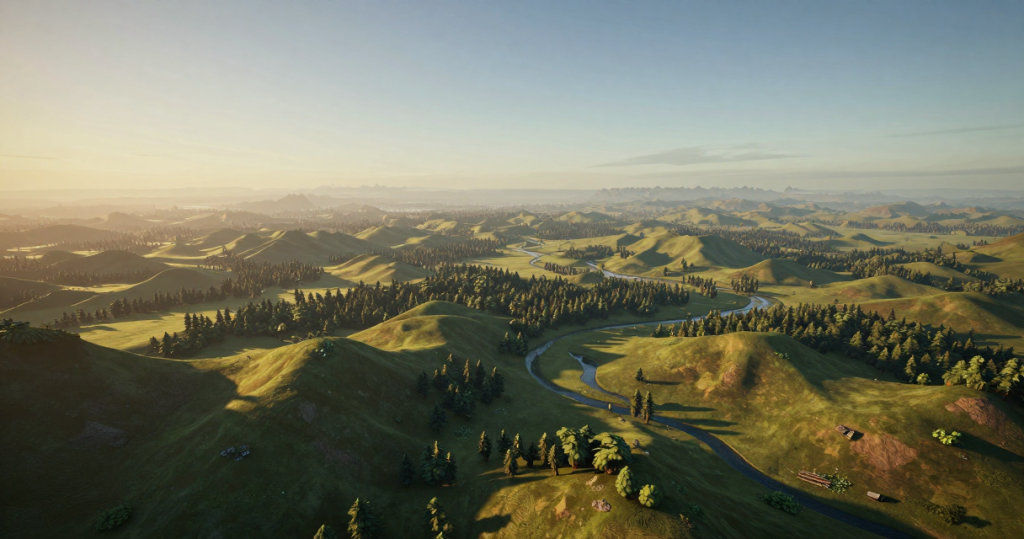
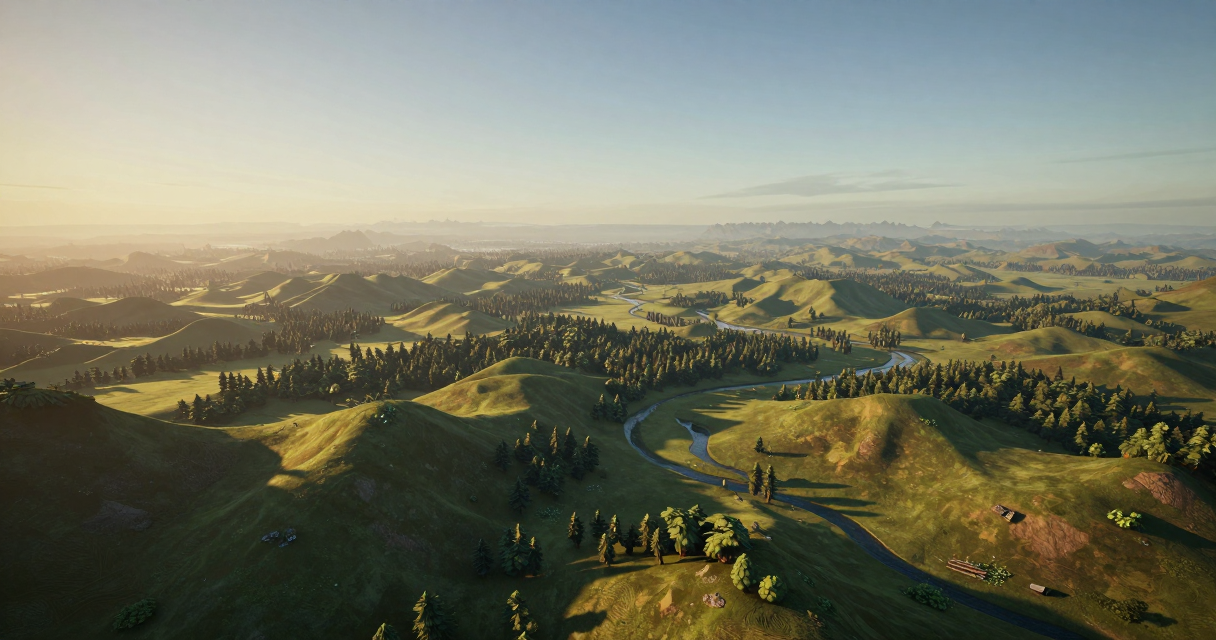
Procedural generation sits at the heart of modern infinite game worlds because handcrafting every kilometer of terrain is impossible for any studio budget. The architecture of these systems often relies on spatial partitioning trees where the smallest unit of work is the leaf node that finally gets rendered or simulated. Developers who understand how to structure this final subdivision gain control over memory budgets, streaming latency, and the visual variety that keeps players engaged across thousands of hours. This article breaks down the concrete strategies that turn abstract math into playable continents without melting the GPU or flooding the artist pipeline.
Hierarchical Subdivision and the Role of the Leaf Node
A typical world generator starts with a root bounding volume that covers the entire playable area and recursively splits it using quadtrees for 2D heightmaps or octrees for full volumetric data. Each split halves the region until the cell size matches the target resolution of your terrain tiles or chunk meshes. At that terminal depth the algorithm stops recursing and hands the cell off to the meshing or instancing stage. The leaf node is therefore the atomic unit where procedural noise, biome rules, and object placement converge into actual triangles or entity spawns. If the subdivision stops too early you get blocky artifacts; if it goes too deep you drown the CPU in draw calls and the GPU in vertex throughput. Most production engines clamp the maximum depth between twelve and sixteen levels depending on whether the camera stays grounded or supports orbital views.
Choosing the split heuristic matters as much as the depth limit. Uniform subdivision wastes budget on empty ocean or flat plains while adaptive schemes measure local variance in noise derivatives or biome boundary proximity. A common trick is to precompute a cheap variance metric on the CPU during the first pass and only refine cells where the metric exceeds a threshold. This keeps the tree shallow over deserts and deep near mountain ridges where geometric detail pays off visually. The heuristic must run fast enough to not stall the main thread so developers often approximate variance with a few sample points rather than full integral evaluation.
Noise Evaluation Strategies at the Terminal Cell
Once the tree hands off a terminal cell the generator must fill it with coherent height, material, and object data. The classic approach evaluates a stack of Perlin or Simplex octaves at every vertex but that scales poorly when a single leaf node contains thousands of vertices. A faster pattern bakes the noise into a small texture atlas on the GPU using a compute shader where each thread handles one texel. The atlas resolution matches the cell vertex density so a 65 by 65 vertex patch becomes a 64 by 64 texture. By offloading computations to the GPU parallel processing, the CPU remains free for handling streaming tasks. The atlas can also store biome masks, erosion deposits, and river flow vectors in additional channels.
For infinite worlds you cannot prebake the whole atlas so you stream tiles on demand. A circular buffer of atlas pages stays resident in VRAM while a background thread issues copy commands for newly visible cells. When the camera moves the system evicts the least recently used pages using a simple LRU queue. This technique keeps VRAM usage constant regardless of world size and avoids the stutter of synchronous texture uploads. The only catch is handling the one frame latency between requesting a page and sampling it so the meshing shader reads from the previous frame’s atlas while the new one uploads.
Biome Blending Without Cracks
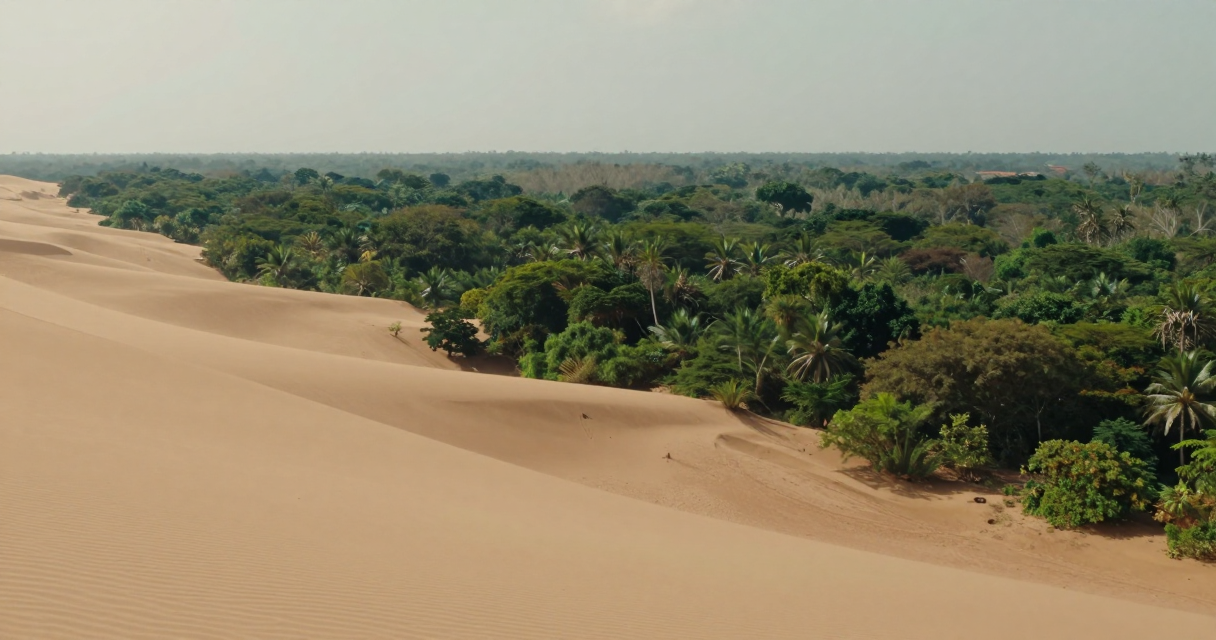
Adjacent terminal cells often belong to different biomes and a hard boundary creates visible seams in both geometry and texture splatting. The standard fix blends noise values across a transition zone that spans several cells but that requires neighboring cells to agree on the blend weights. A deterministic solution hashes the cell coordinates into a pseudo random gradient vector and uses dot products to compute a smooth falloff that is identical no matter which side evaluates it. Because the hash is stateless the blend stays consistent even if cells load out of order or get evicted and regenerated later. The gradient magnitude controls transition width so you can widen it for gradual climate shifts or sharpen it for sudden biome edges like a desert meeting a jungle.
The TUF channel demonstrates how to use Pixel Shaders to scatter trees and grass procedurally in Unreal Engine 5.
Material splatting follows the same principle. Each biome contributes a weight map stored in the atlas alpha channels and the pixel shader blends albedo, normal, and roughness textures based on those weights. To avoid swimming textures when the camera moves the UV coordinates are derived from world space position rather than local mesh UVs. This locks the detail to the terrain so a rock texture stays pinned to the same ridge even as the mesh LOD changes. The tradeoff is increased texture bandwidth but modern GPUs handle the extra fetches easily when the atlases are compressed with BC7 or ASTC.
Instancing Vegetation and Props Inside the Cell
Placing trees, rocks, and debris individually would explode the draw call count so the generator emits instance buffers per leaf node. A two pass approach works well: first a compute shader scatters candidate points using a Poisson disk distribution driven by a hash of the cell origin. The shader writes positions, rotations, scales, and prototype IDs into a structured buffer. Second a culling pass on the GPU tests each instance against the view frustum and occlusion query results then compacts the survivors into a draw indirect argument buffer. This keeps the CPU entirely out of the per frame instance loop.
Density masks prevent vegetation from spawning on steep slopes, underwater, or inside roads. In game sound design, density masks help control spatial audio placement for immersive environments. The scatter shader reads the mask at each candidate point and rejects the point with probability one minus mask value. Because the mask is derived from the same noise that shapes the terrain the vegetation naturally follows ridges and valleys without extra authoring. Artists can still paint density adjustments in the editor by stamping a low resolution override texture that the shader multiplies with the procedural mask.
Streaming and Priority Management
An infinite world only exists where the player looks so the streaming system must decide which leaf node gets processed next. A priority queue orders cells by a score that combines camera distance, view frustum inclusion, and gameplay relevance such as quest markers or multiplayer teammates. Cells inside the inner radius of two hundred meters get top priority and are processed synchronously on the main thread to avoid pop in. The middle ring out to one kilometer runs on a worker thread with a frame budget of two milliseconds. The outer ring beyond one kilometer is purely predictive and can take several frames to finish. This tiered budget prevents the streaming thread from starving the render thread during fast travel or teleportation.
When memory pressure spikes the system evicts cells from the outer ring first using the same LRU policy as the texture atlas. Eviction is not instant; the cell mesh and instance buffers are marked stale and the memory is returned to the pool only after the GPU finishes any pending draw calls that reference them. A fence sync object guarantees safe reuse without stalling the pipeline. This deferred free pattern eliminates the hitches that plagued earlier streaming implementations where synchronous deletes blocked the command buffer.
Determinism and Multiplayer Synchronization
In a shared world every client must generate identical geometry for the same coordinates without exchanging massive terrain buffers. The solution is pure deterministic functions seeded by a global world seed and the cell integer coordinates. All noise, hash, and scatter functions are implemented as stateless HLSL or GLSL functions so they produce bit identical results on AMD, Nvidia, and Intel hardware. Floating point non determinism is avoided by using integer arithmetic for hashing and by clamping noise evaluation to a fixed precision grid. The only data transmitted over the network are dynamic entity states; the static world is implicit.

Versioning becomes critical when you patch the generation algorithm. A schema version number stored in the save file tells the loader which generator revision to run. If the version mismatches the client falls back to a compatibility shim that replicates the old math for already visited regions while using the new algorithm for fresh cells. This prevents terrain seams at the boundary between old and new chunks. The shim adds a few kilobytes of shader code but saves weeks of world rebuilds after each content update.
Debug Visualization and Authoring Tools
Procedural systems are opaque by nature so you need tooling to see what the generator is actually doing. A debug overlay renders the subdivision tree as colored wireframes where hue encodes depth and saturation encodes the variance metric that drove refinement. Clicking a cell prints its noise seed, biome weights, and instance count to a console window. This lets a technical artist spot over refined flat areas or under refined mountain peaks in seconds. The overlay also highlights cells currently in the streaming queue so you can verify the priority logic matches the design intent.
Authoring biome palettes works best with a node graph where each node outputs a noise function or a blend operation. The graph compiles to the same shader code the runtime uses so there is zero discrepancy between editor preview and game. Artists can scrub a world position slider to see how the biome transitions evolve across thousands of kilometers without leaving the editor. The graph also exposes parameters like mountain frequency or river density as sliders so designers can iterate on feel without asking engineering for code changes. This tight loop between visual feedback and parameter tweaking is what turns a tech demo into a shippable infinite world.

I’ve been playing video games since I was a kid, and that passion naturally led me to explore how they’re made. I love diving into game design concepts and sharing insights with fellow enthusiasts. When I’m not testing new titles, I’m tinkering with Unity and learning new programming tricks.